OUR VALUES
Episode 4 – Operational Intelligence
Late 2025, a lot of shop owners are walking into 2026 with one question on their mind: how do I get more cars in the door?
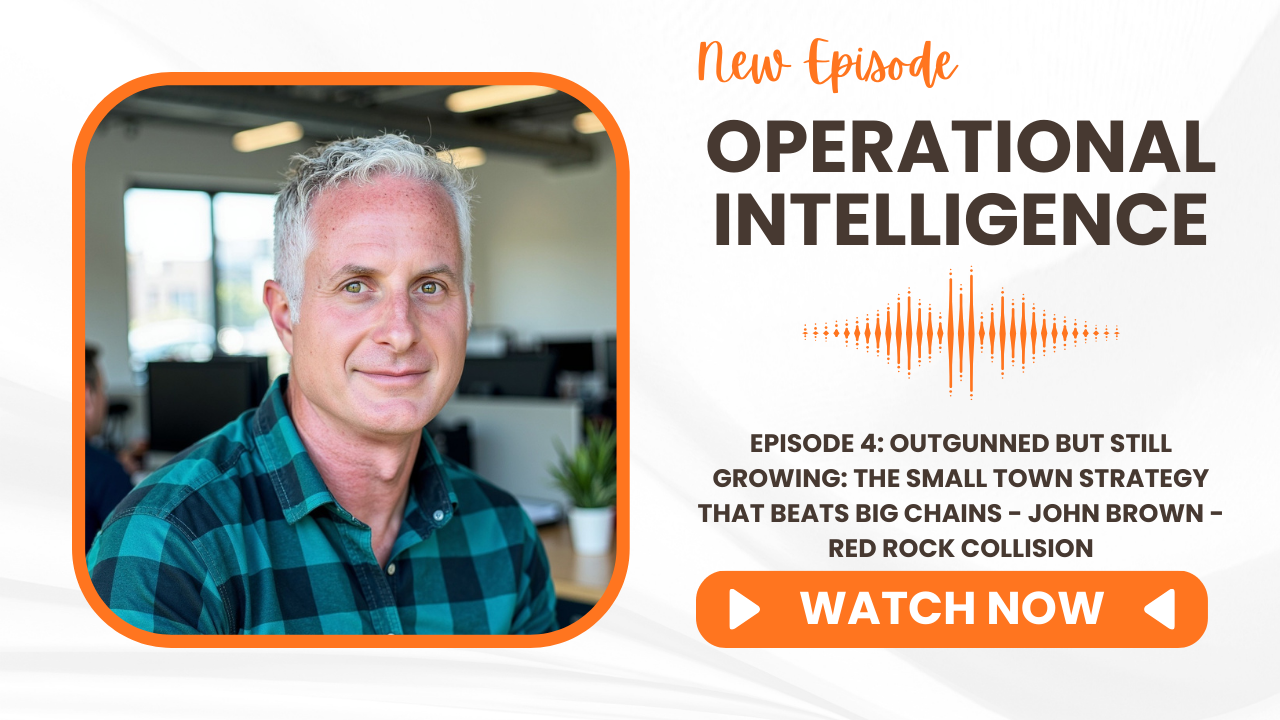
In Episode 4 of the Operational Intelligence Podcast, I sit down with John Brown of Red Rock Collision in Cottonwood, Arizona, the only independent shop left in a market surrounded by consolidators. His competitors are DRP-fed. Steering is a daily reality. And yet, with the cards stacked against him, John is not just surviving. He is winning, growing, and building a new larger facility.
This episode is not generic branding advice. It is a practical breakdown of how an independent shop earns trust fast, converts more of the opportunities it already gets, and keeps winning business even when the big boxes are everywhere.
The Real Problem: You’re Not Competing Against Shops, You’re Competing Against Steering
John makes it clear that steering is not an occasional inconvenience. It is the baseline environment.
He sees it constantly, even with customers who tell the insurer directly, “I’m taking it to Red Rock.” The insurance company still tries to redirect them before John ever gets a chance to talk to them.
That is why this episode matters: if steering happens upstream, the independent shop’s leverage is downstream, in the first real conversation when the customer finally reaches you.
And John’s whole system is built around winning that moment.
This Episode Is Really About Winning the First 15 Minutes
Most shops treat the first visit like an estimating task:
-
write the estimate
-
email it over
-
follow up later
John’s point is simple: that is how independents lose jobs.
If the customer leaves without commitment, the next call they get is usually from the insurer or a DRP partner, and the steering starts again. So Red Rock treats the first interaction like an operational process, not a quote.
His advantage is not being louder. It is being more intentional when the customer is most vulnerable and most persuadable.
The Red Rock Playbook: How an Independent Converts More Work Without DRPs
Here are the most actionable systems John lays out in the episode.
1) Lead With Consumer Education, Not the Estimate
John’s marketing and first conversation center on one idea: the customer’s right to choose.
He reinforces it everywhere:
-
social content
-
radio and local placements
-
in-person conversations
-
the way his team explains the claim process
The goal is not to “bash insurers.” It is to make the customer confident enough to resist the script they are about to hear.
2) Replace “Estimate Writing” With “Claim Process Leadership”
One of John’s strongest insights is this: customers do not want to interpret three competing estimates. They want certainty.
So instead of trying to win on price or line count, he walks the customer through:
-
what happens next in the claim
-
what steering looks like
-
what the insurer may say
-
how Red Rock will advocate for the customer
-
what the customer should say back
That shift turns the shop from a vendor into a guide. And it changes the customer’s posture immediately.
3) Use the Repair Contract as a Commitment Device
This is one of the most unique tactical takeaways I have heard from an independent operator.
John does not treat scheduling as “hope they come back.” He uses a repair contract so the customer understands they are committing to the repair, and the shop is committing time, parts, and labor planning.
He explains why it matters:
-
If the customer leaves without commitment, steering has another chance to steal the job.
-
A signed contract creates clarity and reduces churn.
-
It also gives the customer a simple steering-stopper: “I already signed a contract with the shop.”
John has only had to enforce it rarely, but he emphasizes that the existence of the contract changes behavior on both sides. It makes the relationship real before the car is even dropped off.
4) Win by Being Human While Big Shops Get Robotic
John sees a post-COVID shift: big shops leaning harder into web forms, photo estimates, and automated intake.
That helps independents who can do what the big boxes struggle to do at scale:
-
slow down
-
listen to the story
-
create comfort
-
build trust in the first conversation
He even points out a detail most shops miss: customers often arrive after they already had a bad experience somewhere else. So your job is not just “write an estimate.” Your job is to re-establish trust and make them feel taken care of.
5) Sell Local Accountability, Not Discounts
John learned early that deductible games might get you a job, but they also brand you in a way you cannot easily shake.
Instead, his differentiator is accountability:
-
you can talk to the owner
-
money stays in the local community
-
the shop is visible in town and involved
-
reputation matters in a small market
He frames it simply: when something goes wrong, are you dealing with the person who owns the outcome, or a ladder of managers somewhere else?
Why This Matters More Than Ever Going Into 2026
Independents are not just fighting other shops. They are fighting systems:
-
DRP-fed volume
-
insurer steering scripts
-
open shop assignments that let insurers get ahead of the conversation
-
customer confusion created by competing estimates and low-information processes
John’s approach is a reminder that you can win in that world, but not by coasting.
You win by building a repeatable front-office process that converts more of the opportunities you already touch.
If You Want More Cars Without DRPs, Start Here
This episode is for any owner who feels like:
-
“we’re getting outflanked by DRPs”
-
“steering is killing us”
-
“customers are confused before they even meet us”
-
“we need more car count but we can’t outspend the chains”
John Brown shows what it looks like to hold the line as an independent and still grow: control the first conversation, build trust quickly, and lock in commitment before steering gets a second shot.
Listen to Episode 4 of Operational Intelligence:
Outgunned but Still Growing
John Brown – Red Rock Collision